
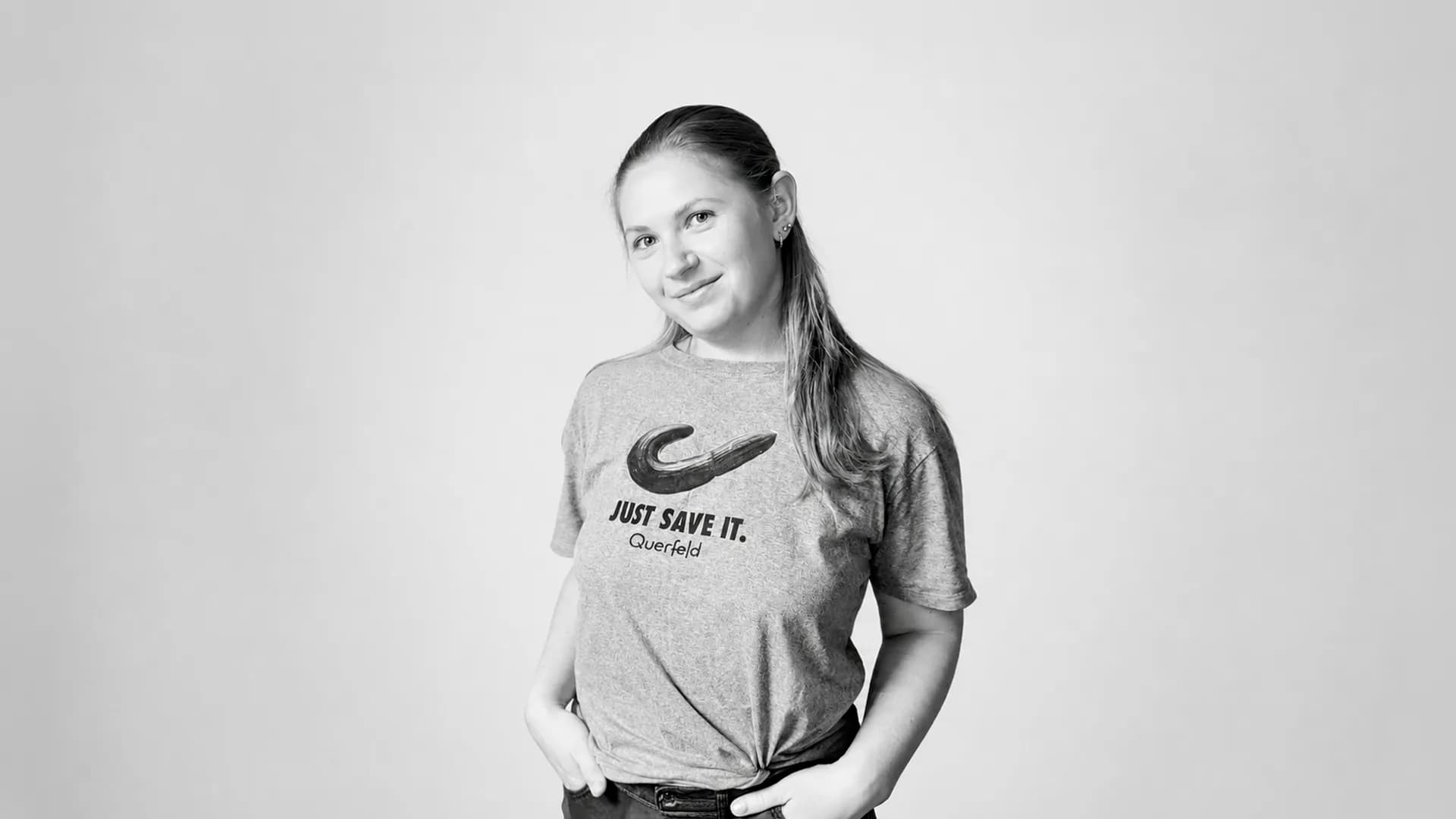
According to the Federal Environment Agency, nearly 11 million tons of food are wasted in Germany each year. Appreciation looks different. It starts with the classification of goods into two categories: A-grade and B-grade. Fruits and vegetables must meet certain standards, primarily regarding weight and shape. B-grade produce includes:
Deformations
Scarring
Oversized
Undersized
The idea behind the marketing company Querfeld was originally to raise awareness about food waste and appreciation. It quickly evolved into a wholesale business, and today Querfeld sells B-grade produce to customers such as daycare centers, canteens, and restaurants.
We explicitly want to avoid stockpiling. That’s why we don’t order large quantities hoping they will sell. Because then we end up with food waste, which we want to avoid.
Therefore, the process is regulated. Querfeld sends offers from producers to customers, who place their orders and receive their deliveries after the harvest.
In the last ten years, we have definitely saved 2.4 million tons of food. Specifically B-grade. But we also sell A-grade from our producers to make it logistically worthwhile.
Yana Graf refers to this as the sensible movement of transport trucks. As logical, cost-effective, and CO2-saving as possible. Even though many still need to learn that B-grade produce also consumes resources and that producers need to earn money from it and cannot give it away for free.
The plant was planted, consumed land, required water to grow, and there were people who harvested and transported it. All of this costs money. But due to its shape, it has to be sold at a slightly lower price.
Even though there are many initiatives like Kantine Zukunft that emphasize organic food while also promoting B-grade produce, it is not easy for the company to make the concept economically viable. Coordinator Yana Graf hopes and works towards changing this in the near future.