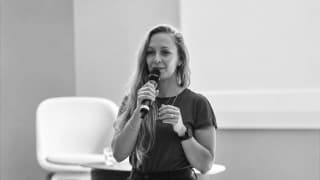
Oxford University states that the creation of the iconic PPE degree Joe studied for “arose from the belief that the advanced study of all three subjects would transform students' intellectual lives, to great social benefit.” As you listen to Joe’s story, you will see just how well that plan has worked!
As part of our summer break, the impact.info team invites you to (re)discover one of our episodes.
You can also find our article on the topic right here .
Enjoy listening!
Killian Flagey
impact.info director
Published on 1 September 2026
Photo credit — Zero Gravity
Transcript Audio in English· AI-generated transcript
0:00 No matter if you live in a sort of council flat tower, in an urban centre like London 0:05 or Manchester, or in a low-income background in a really rural area of the UK, you can 0:10 get access to support directly through your mobile phone, and that means that geography 0:15 no longer has to be a barrier to opportunity. 0:19 Impact.info – doing things differently. 0:23 Hello and welcome to Impact Info, where we inspire you with inspirational stories of 0:29 positive impact. 0:30 For this episode, we're talking about careers. 0:33 How can people live up to their potential in a world that is still fundamentally unequal, 0:39 where it can still be a case of it's not what you know, but who you know, and where 0:44 not everybody knows the right people? 0:47 Our guest today is rolling out real-world answers to those questions. 0:53 My name is Joe Sutton. 0:54 I'm the founder and CEO of Zero Gravity. 0:57 Hello, Joe. 0:58 Hey, Vanessa. 0:59 Great to be on the show. 1:00 So, despite the name, Zero Gravity is not actually about space travel? 1:06 No, we haven't put anyone on the Moon or Mars as of yet, but who knows, in 5-10 years' 1:11 time. 1:12 What Zero Gravity is, is a platform that powers students from low-opportunity backgrounds 1:17 into top universities and careers, and the reason we're called Zero Gravity is when 1:22 I used to speak to a lot of students about this, they'd often talk about coming from 1:25 a low-income background almost being like some kind of gravitational force, pinning 1:29 you down. 1:30 So, I thought, why not go for a metaphorical name about turning that on its head, and that's 1:34 where the name came from. 1:35 How do you define a low-opportunity background? 1:39 The three things that usually really matter is money, how much money has someone got in 1:43 that family. 1:44 Another thing is where they live. 1:46 They live in an area with loads and loads of jobs and educational opportunities, or 1:50 an area where those are few and far between. 1:53 The final one is education. 1:54 Do they have access to really high-quality education, and when you bring those three 1:58 things together, you usually get some sense of where someone is on the socio-economic 2:03 spectrum. 2:04 Yeah, because according to the World Economic Forum, the UK as a whole actually has a very 2:09 low social mobility rate, doesn't it, for a country in the global north? 2:14 I know we rank 21st in the world, below most of Europe, below Singapore, below Australia. 2:21 Why do you think that is? 2:23 So you're absolutely right, the UK does not do very well when it comes to social mobility. 2:28 Indeed, when you look at the data, you can predict around 45% of what someone earns across 2:34 their lifetime by looking at what their parents earned, so the kind of stickiness of income 2:38 across generations is very strong in the UK. 2:41 A big part of that is education. 2:44 Education explains around 50% of those differences. 2:47 The UK has a system where there's really big gaps in terms of how well people do at school 2:52 based on whether you go to a state school or a private school, or go to just a good 2:56 state school in London versus a poor state school outside London. 3:00 But the other thing as well is kind of access to the workplace and progression within it. 3:06 In the UK, we've got a very stratified system around jobs, where if you didn't go to university, 3:12 it's really, really difficult to get a high-paying, entry-level job. 3:17 And so, at Zero Gravity, you offer, I know, mentoring and I think training too, presumably 3:24 to counter that sort of social inertia. 3:27 Exactly, and we try and get students from low-opportunity backgrounds into top universities 3:33 and careers. 3:34 And the way we do that is by making it really, really easy to essentially get the information, 3:39 the knowledge and the support you need through your mobile phone to navigate these really 3:44 complex processes. 3:46 So we just make sure students know what it takes to get into these really highly competitive 3:51 institutions. 3:53 But the key thing about what we do is it's completely digital. 3:56 So no matter if you live in a sort of council flat tower in an urban centre like London 4:01 or Manchester, or in a low-income background in a really rural area of the UK, you can 4:07 get access to support directly through your mobile phone. 4:10 And that means that photography no longer has to be a barrier to opportunity. 4:14 You say it's completely digital, but there are real people on the Zero Gravity end of 4:19 things. 4:20 Exactly. 4:21 So we call it digitally-powered, human-driven. 4:24 The digital infrastructure is what makes it really easy to access and creates that consistent, 4:29 high-quality support. 4:30 We're an app that actually brings real human beings together to try and create change. 4:35 So mentoring, for instance, is a real key part of our model. 4:39 We connect people with a mentor who's one step ahead of them on the journey, and having 4:43 that real human being who's kind of in the institution that you want to get into yourself, 4:48 give you the inside track about what it takes, doesn't just give you the kind of functional 4:52 support you need to navigate those processes, but also that sense of kind of human connection 4:59 where finally it feels like you've got someone who understands your ambition, who's there 5:03 in your corner backing you all the way. 5:06 Yeah, so you end up with the who you know, in effect. 5:09 Exactly. 5:10 And we're trying to bring that network advantage that you get if you go to an elite private 5:13 school or come from an affluent area to students wherever they live and whatever sort of school 5:19 they go to. 5:20 We know that if you go to a private school, you're more likely to know over 10 people 5:24 who went to Oxbridge than someone from a low-income background is to know even a single person 5:29 who went to Oxbridge. 5:30 And we're trying to change that with our platform by bringing together these tens of thousands 5:34 of talented students with low-opportunity backgrounds who often don't know each other, 5:38 but should know each other because this is the next generation of leaders. 5:42 Now, I know you talk about spotting and unlocking unrecognized talent, how do you actually do 5:49 that? 5:50 So the reason we talk so much about unrecognized talent is this isn't about charity. 5:57 Like yes, increasing social mobility and access to opportunity is the right thing to do. 6:02 It is about fairness and equality, but ultimately this should be good for everyone. 6:07 Societies thrive when they're best able to unlock all of the talent that lives within 6:11 their country rather than just a segment of it. 6:14 So we've sort of convinced both universities and employers that working with an organization 6:18 like Zero Gravity is not just about diversity, but it's about actually finding the people 6:24 who are going to be shaping the next generation of your institution. 6:28 And the way we do that is incredibly data-driven. 6:30 We look at data not only about people's backgrounds, but also about the context in which they have 6:35 achieved their academic results. 6:37 Now, too often in the UK, we sort of look at really poor indicators of potential, like 6:42 someone's grades or the headlines on their CV. 6:46 Those things are pretty useless unless you know the context in which those results have 6:51 been achieved. 6:52 So we've built this sort of data-driven system where finally we can show universities and 6:55 employers this person from a state school in Liverpool is that standout candidate that 7:01 you really, really want. 7:03 And they might not look incredible on paper, but when you look at what they've achieved 7:06 in context, this is a huge, huge outperformer and it should be in your institution. 7:11 And is it the schools that give you that data? 7:14 So around 50% of Zero Gravity members sign up themselves, around 50% are referred from 7:20 their schools. 7:21 And we've got partnerships with around a third of all of the state schools in the UK, which 7:26 makes it really easy now to sort of pinpoint a lot of this talent within the state education 7:32 system. 7:33 But ultimately, it's going to be the student who's driving the experience. 7:37 So we put a huge amount of investment on working with the individual. 7:41 Okay, so clearly you're doing great things. 7:44 I'm curious as to how you keep it going, sort of logistically, financially, what's the model? 7:51 It hasn't been an easy ride and I started Zero Gravity originally from my student bedroom 7:56 with the last 200 quid of my student loan. 7:59 But nowadays, we've got a revenue model where essentially we get paid by leading employers, 8:05 top universities and also local government to essentially make it easier for them to 8:09 recruit top talent from low opportunity areas. 8:12 And the reason I like that revenue model is it aligns the commercial impact with the social 8:17 impact. 8:18 Now the better job we do to actually get students into these opportunities, the more revenue 8:22 we can generate to keep the organization going. 8:24 So you create that really nice flywheel between your impact and your commercials, which is 8:29 something that's missing in a lot of businesses in the UK, where they might be financially 8:33 successful but not necessarily have a positive impact on society. 8:37 And it remains completely free then for your users? 8:40 Absolutely, completely free for students, always will be because we want to work with 8:44 people who can't afford to pay. 8:47 Yeah. 8:48 Now you founded the company five years ago now, could you share the story of one of the 8:52 people you have mentored at Zero Gravity? 8:55 Sure. 8:56 So there's over 15,000 students who since we've launched Zero Gravity have used the 9:01 platform to win an offer at a leading UK university. 9:05 But behind every single one of those data points is a real human being. 9:08 And one of my favorite stories, we had a member called Millie, who was from a traveling showman 9:16 background in the UK. 9:17 And she dropped out of school when she was in her teenage years and actually sat her 9:21 GCSEs at home. 9:22 And she got a really solid set of grades, given her kind of context of educational disruption, 9:28 but not the sort of grades on paper where you necessarily think that this person's a 9:31 straight A student and they're going to go to the stars. 9:34 But she was so motivated and so interested in classical civilization in particular, she 9:39 used our platform to work for mentor to self learn Latin. 9:44 And she ended up applying to Oxford University and won an offer to study classics and was 9:48 one of the first traveling showman for a generation to go to Oxford University. 9:54 Incredible story of someone who defied the odds that managed to sort of achieve something 9:59 that a lot of people would never have thought was possible. 10:01 And we helped support her into a career and she's now actually working at Paramount Studios. 10:06 So really, really cool job in the creative industries in the UK. 10:10 And it's incredible to have members like Millie on the platform. 10:16 A last question, a more personal question. 10:21 Can I get you to remember Joe Seddon at 16? 10:26 What would he think of where you are today? 10:29 I think he would think it was completely unfathomable that you could start a business in your bedroom 10:35 and scale it into what is now, according to the Financial Times, the 36 fastest growing 10:40 business in the UK. 10:42 If you grew up in an area like I did in Morley and West Yorkshire, you don't necessarily 10:46 see these opportunities immediately in front of you day to day. 10:50 And one of the things I really want to change for students is make them actually understand 10:55 the expanse of what's possible. 10:57 Too many people self-select out of going to top universities or going into that top career 11:02 or starting a business because they think they don't have what it takes. 11:05 But the reality is, is there's millions of talented people out there in the UK who are 11:09 suffering from that dearth of confidence, from that imposter syndrome, from that sort 11:13 of tyranny of low expectations. 11:16 And turning that on its head is what Zero Gravity is all about. 11:18 And if we can do that, it's not just great for the individuals themselves, but the entire 11:23 country. 11:24 Joe Seddon, thank you very much. 11:25 Great to be on the show, Vanessa. 11:26 Thank you. 11:27 That was impact.info, doing things differently. Embed this interview on your site
Show this player directly on your site to share the interview with your audience.
Copy embed code View generated code
Paste this code into an HTML/code block on your site: “Custom HTML” on WordPress, “Embed a Widget” on Wix, a “Code” block on Squarespace.