
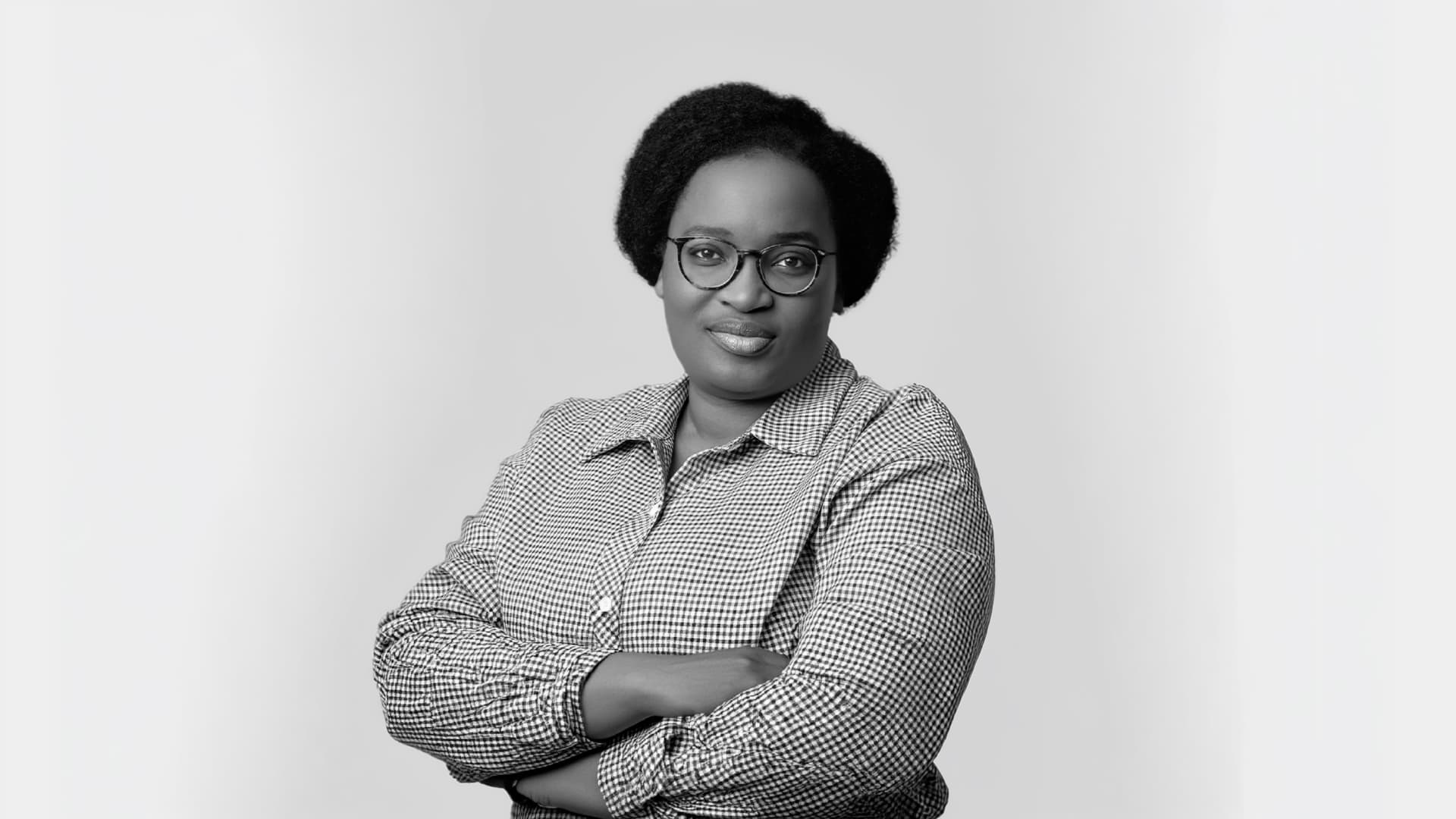
“I evolved in the tech world and then started my career as a researcher and teacher,” says Daniella Tchana. “And I realized that there were very few women in engineering schools. On average, there were 3 girls out of 35-40 students. I also noticed that in the national mathematics Olympiads, there weren't many girls on the podiums, even though they are just as good at math as boys.”
So, in 2019, the young woman decided to change the rules by launching the Women’s Mathematics Olympiad, under the auspices of her association, which she named STEM4All.
The first step is to show that these careers offer attractive salaries. The second is to demonstrate that many women are already in these fields by providing role models for them to identify with. The third goal is to prove that we do not progress alone, but in sisterhood, together, as a group, relying on our peers.
This foundation shaped the format of the championship. Therefore, it is now the only high school competition that awards checks to the winners.
Next, the association identifies women in tech careers, creating profiles that are then presented to young women to provide them with these important role models. “When we talk about profiles, what interests us most for these young girls is the academic journey and then the professional path leading to the positions these women hold today.”
The competition takes place in two phases: a first phase that is completely individual, followed by a second phase in groups, where the young girls form teams of three. Without knowing each other beforehand, they have two weeks to tackle and submit a math topic. This approach highlights sisterhood and mutual support.
“It shows that to succeed in this field, which today does not belong to us and is very male-dominated, we need to support each other as women. Therefore, it is the group that wins the prize, not the individual,” emphasizes Daniella Tchana.
In 7 years, STEM4All has already supported over 5,000 young girls through this championship.
Beyond this championship, STEM4All offers the Booster Sciences program, which helps girls succeed in entrance exams for higher education and prestigious schools after preparatory classes, as well as integrating into preparatory classes when they face difficulties in math, physics, or chemistry. And it is completely free.
There is also the ROOTS program, which addresses the issue at its roots by supporting women, girls, and boys in priority neighborhoods designated by the state. This is complemented by a mentoring program for higher education students and a scholarship system to encourage them to enter prestigious schools, which are often private and therefore very expensive.
This audience represents a real opportunity for society. “A diverse, inclusive company is a company that will be more effective,” insists Daniella Tchana. “Working with profiles from different social groups and genders brings innovation. Governing with a team, a board, coming from a variety of territories, profiles, and structures allows us to address most of society's issues.”
“So really, it’s a win-win situation, both for companies and for our nation,” concludes Daniella Tchana.