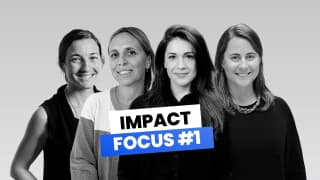
Diversidays, co-founded in 2017 by Anthony Babkine and Mounira Hamdi, supports all underrepresented talents or those who may face discrimination in tech, including women, individuals from priority neighborhoods or rural areas, people with disabilities, youth, and older individuals, to help them find their place in digital professions and entrepreneurship.
Only 10% of French people believe they live in a country where everyone truly has a chance, and 35% report having experienced unfavorable or discriminatory treatment in the past 5 years due to one of the discrimination criteria, notably among the most common: gender, age, pregnancy, maternity leave, origin or skin color, religion, health status, and disability.
All these inequalities mean that today a number of people struggle to access all opportunities, particularly in the digital sector. For example, only 24% of women are digital professionals, with a wage gap of 16%, according to Insee.
“It's a whole bunch of figures that accumulate and paint a picture where it can sometimes be difficult to find one's place. And when, on top of that, you combine certain factors, like being a woman living in a priority neighborhood and suffering from a disability, access to employment can be particularly challenging,” explains Iris Avital.
Yet, the digital sector is currently the fastest-growing employment sector, with an acceleration that is on average 2.5 times faster than in other fields.
Thus, Diversidays offers free support programs for its beneficiaries to assist them in starting their businesses, particularly in creating impactful solutions in tech, or for job seekers wishing to acquire new skills, reimagine professional projects, either in digital professions or those requiring digital skills in daily life.
In parallel, Diversidays conducts annual studies to assess the ecosystem and also organizes a major festival, Uniques, focused on equality of opportunity in action, to help change mindsets among all and raise awareness of the solutions available in each territory.
"The goal is to ensure that in the companies of tomorrow, and even today, there is a diverse population to provide representation of profiles in the solutions they can offer and in the image they can project.”
“The actions we undertake also aim to break certain stereotypes, challenge preconceived ideas, and allow some to overcome the barriers imposed by society. And sometimes, we impose these barriers on ourselves a little, by not seeing ourselves, due to a lack of representation, in the professions we could envision for the future,” concludes Iris Avital.