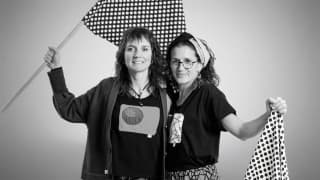

"Rather than focusing on the Francophone vision of public speaking, which is heavily centered on the beauty of the text, a certain lyrical aspect, the polysemy of words to create figures of style, rhetoric, and please the ear, we believe that speech structures lives and trajectories, and therefore it should be used as a tool for emancipation,” explains Greazi Abira.
And this emancipation comes through exchange and dialogue. That’s why Graine d’Orateur promotes public speaking through debate, to develop critical thinking and learn to argue, to refute theses, “with the aim of defending and standing up for oneself.”
The association works in middle and high schools, with a non-exclusive focus on young people from underprivileged neighborhoods. “We believe it is important for young people from popular backgrounds to see others who have gone through their reality.” Thus, the workshop facilitators are almost exclusively former beneficiaries.
“The idea is not so much to turn them into Aristotles, Ciceros, or Jaurès, but rather for them to reclaim speech with a view to socio-professional integration,” specifies Greazi Abira. “I speak of social integration simply because speech is what makes us exist. And of course from a professional standpoint, since there are mandatory exercises, like the famous job interview, that determine access to employment.”
The vocabulary differs depending on the social environment in which one is born and has evolved. The number of words one masters is not the same, nor is the number of words one has been exposed to. In France, social origin remains a very important marker in life trajectories today.
“Therefore, we need to conduct actions with certain audiences to try to restore a kind of equality. We believe that meritocracy cannot exist if we do not give people the same chances to access certain spheres,” insists Greazi Abira.
At the end of their time with Graine d'Orateur, two-thirds of the beneficiaries feel much more legitimate in their ability to speak in public. "So there is a real catalyst for confidence through the workshops we offer.”
"Moreover, they really feel that they have progressed in their mastery of speech. Finally, they have a more eclectic culture and they engage more in public life, whether by speaking for themselves, attending conferences, going to cultural venues, or becoming associative or political activists in their city, or by joining Graine d’Orateur to, in a way, redistribute what they have been given,” concludes Greazi Abira.